Intro
My work in Yanik Lab spans the physical side of biosensing research: chip fabrication, deposition hardware, lab automation, signal delivery, electrochemical workflow development, optical inspection, data collection, and documentation.
The best way to describe the work is not as one project, but as a set of connected systems built around experimental bottlenecks.
Purpose
The purpose of this work is to make biosensing workflows more repeatable, automated, and usable. That includes fabricating chips, building supporting hardware, replacing fragile manual steps, documenting methods, and designing tools that can be used by other researchers.
Much of my role is practical support at the bench: setting up equipment, cleaning substrates, fabricating chips, inspecting results, labeling data, and building the hardware needed when the existing workflow gets in the way.
Workstreams
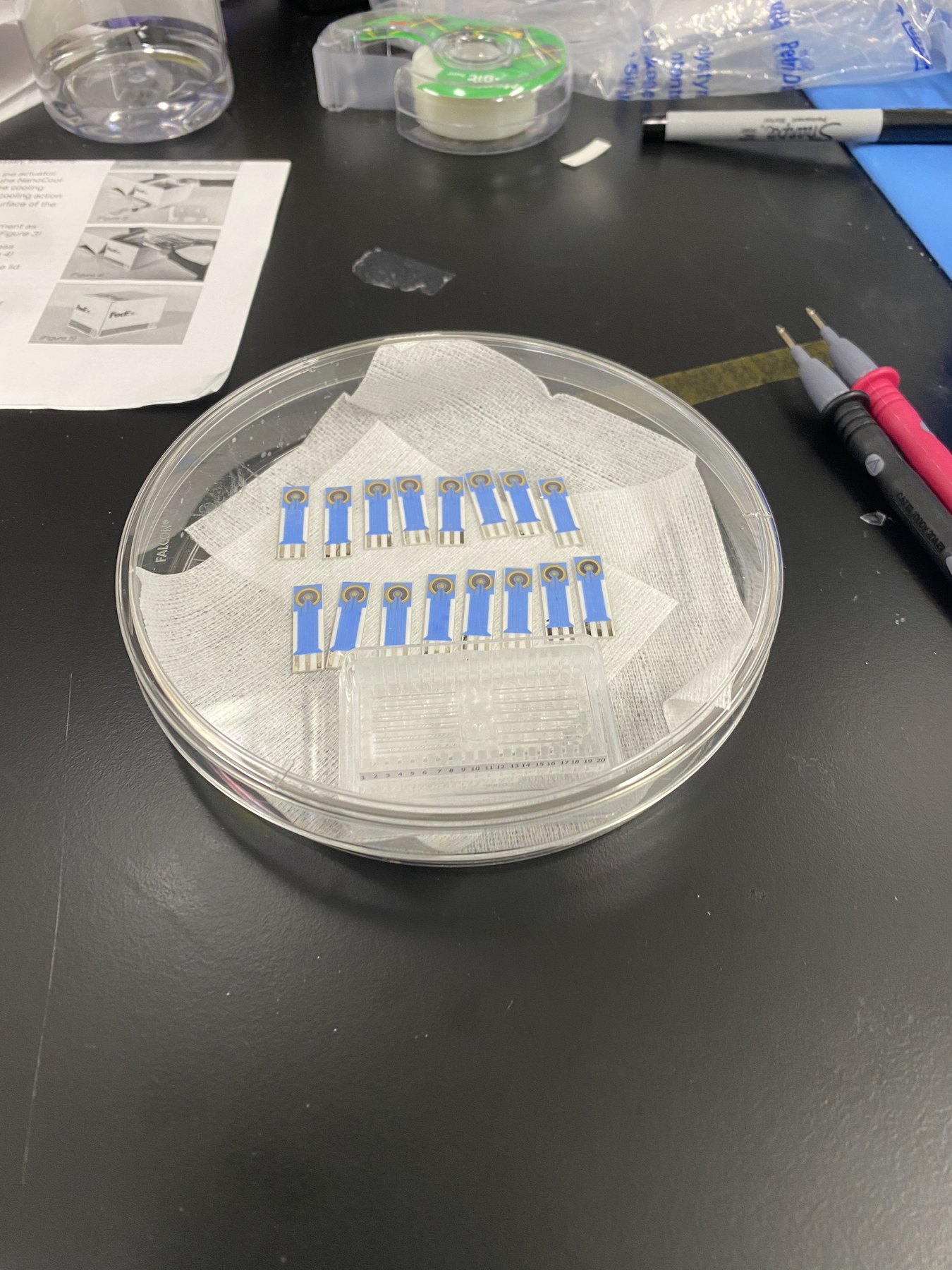
Ti/Au microelectrode chip fabrication
I fabricate biosensor chips on glass substrates using photolithography and lift-off:
- Substrate preparation through solvent and plasma cleaning
- Photoresist spin-coating and soft-bake
- UV exposure through a chrome mask defining electrode geometry
- Development to define metal deposition windows
- E-beam evaporation of Ti adhesion layer and Au sensing layer
- Lift-off in acetone to define clean Ti/Au electrodes
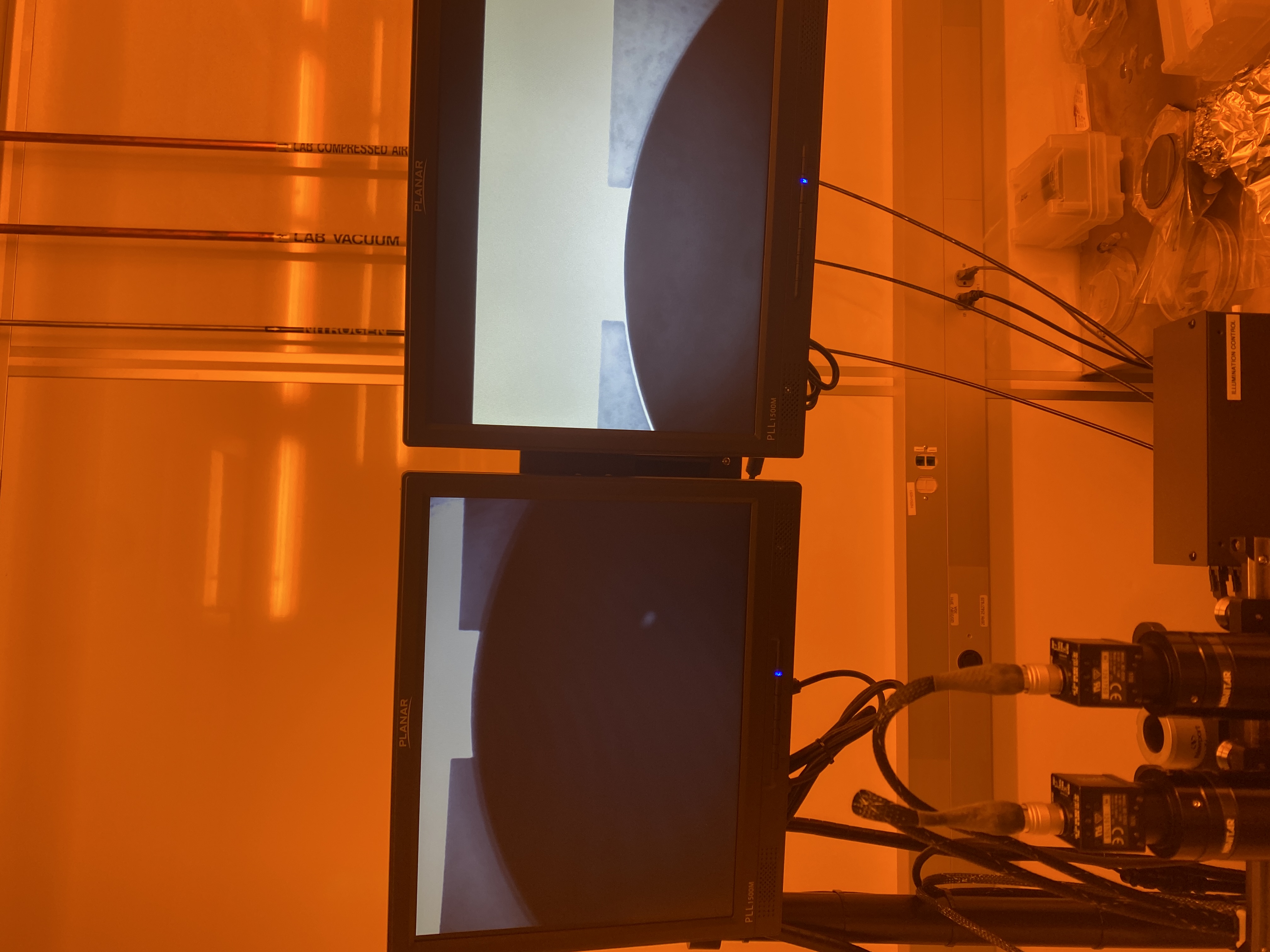
- Optical inspection, yield tracking, and failure-mode documentation
Tooling and process experience includes the O2 plasma cleaner, photoresist spin coater, hot plates, UV mask aligner, fume hood / chemical bench, e-beam evaporator, optical microscope, and manual substrate / photoresist handling. The sequence is the work: clean, coat, bake, expose, develop, deposit Ti/Au, lift off, inspect, and document what failed.
Design decisions
| Decision | Selected direction | Why it mattered | Tradeoff / next step |
|---|
| Fabrication focus | Ti/Au electrodes on glass | Directly supports the lab’s biosensor assays | Yield and failure tracking remain central |
| Workflow improvement | Build small tools around bottlenecks | Saves researcher time without replacing the full assay system | Each tool has to survive real bench use |
| Validation style | Optical inspection plus electrical checks | Connects fabrication quality to measurable experiment output | More standardized data logging would help |
| Automation | Opentrons-compatible hardware and protocols | Makes deposition and assay steps more repeatable | Benchtop use still needs clear handoff documents |
| Documentation | Methods, labels, and run notes | Makes work transferable to other researchers | Needs ongoing cleanup as designs evolve |
Inspection and data handling
After fabrication and deposition, I helped inspect chips optically, collect images, label data, and prepare results for downstream analysis. Some concentration analysis was completed by PhD students using MATLAB workflows.
ADOpt signal-delivery module
A compact 555-timer module that replaced a benchtop function generator in the deposition workflow. Two modules were deployed to Grenada. See ADOpt for full detail.
Opentrons OT-2 workflow support
Python protocols for the Opentrons OT-2 liquid-handling robot, including labware loading, pipette setup, reagent dispensing, incubation timing, wash cycles, and command sequencing for biosensor deposition and assay workflows.
Sensor Deposition Unit
An active electrochemical signal-routing subsystem adding deposition and sensing capability to Terry/ASATS. See Sensor Deposition Unit for full detail.
Manuscript and methods support
Documentation and methods writing in support of related hardware publications, including the ADOpt deposition module framework.
Validation
Validation depends on the workstream:
- Fabrication: chip inspection, yield, failure modes, process repeatability
- ADOpt: oscilloscope validation, optical deposition results, Grenada field deployment
- OT-2 protocols: successful execution of workflow steps
- Sensor Deposition Unit: pending board bring-up and electrochemical validation
Results
- Fabrication and process experience with Ti/Au biosensor chips
- Hands-on cleanroom and wet-lab equipment experience
- Hardware development for automated deposition workflows
- ADOpt deployment to Grenada
- Optical inspection, data labeling, and methods support
- Active development of multiplexed electrochemical deposition/sensing hardware
Future work
- Continue improving chip fabrication repeatability and documentation
- Bring up and validate the Sensor Deposition Unit
- Expand automation around deposition and sensing workflows
- Confirm exact equipment names for a more precise lab-process inventory